omniVUE Intelligence for Healthcare Operations
Predict demand. Build better schedules. Respond before the shift breaks.
Bring workforce demand, availability, skill mix, scheduling rules and live operational pressure into one human-supervised decision environment.
WORKFORCE COMMANDHSC / Emergency Department
SHADOW PILOT
Projected demandHigh+12% vs baseline
Proposed coverage92%2 RN gap identified
OT exposure$32.4KIllustrative 14-day risk
Constraint checkPassedProposed roster
DEMAND FORECAST / 14 DAYSIllustrative data
Forecast demand Available staffing
PRIORITY GAPWednesday night · 2 RN short
Demand forecast exceeds configured safe coverage threshold.
UNIT COVERAGEProposed schedule v04
UnitDemandCoverageVariance
HSC EmergencyHigh92%−2 RN
4 North SurgeryModerate100%Balanced
5 South MedicineRising96%−1 LPN
Float PoolAvailable—+3 qualified
MON96%
TUE94%
WED86%
THU98%
FRI100%
The operational challenge
Static rosters meet a health system that never stands still.
Patient demand changes, staff call in sick, beds lock, qualifications matter and every coverage decision is shaped by policy, availability and collective agreements. The result is often a last-minute search for coverage when the most expensive options are the only ones left.
omniVUE Intelligence is being designed to help teams model that complexity earlier—without handing scheduling authority to an algorithm.
Flagship capability
From predicted demand to a constraint-aware roster.
Forecast the workforce requirement, generate a proposed schedule, explain how each constraint was applied and help coordinators act earlier when reality changes.
Proposed capability · Illustrative data · Coordinator approval requiredShifts with projected premium coverage
Shifts with projected premium coverage
Coverage events available for evaluation
07:00 / DAY15:00 / EVENING23:00 / NIGHT
Mon 27CoveredCoveredCovered
Tue 28CoveredCoveredCovered
Wed 29Covered2 RN gapCovered
Thu 30CoveredCoveredCovered
Fri 31CoveredCoveredWatch
Sat 01CoveredCoveredCovered
Sun 02CoveredCoveredCovered
WHY THIS ROSTER CHANGED
Demand forecast increased for Wednesday evening and night. The proposed roster shifts qualified internal coverage earlier, while preserving configured rest and rotation rules.
HUMAN REVIEW3 recommendations awaiting coordinator review
Forecast demand
Model expected census, acuity and operating pressure from historical and current signals.
Build the roster
Generate a proposed skill mix around staffing requirements, availability, leave and local rules.
Test every constraint
Check rest periods, qualifications, rotation limits, seniority rules and other configured guardrails.
Respond to change
When a call-in or surge occurs, show the operational impact and rank viable coverage options.
Keep people in control
Authorized coordinators review recommendations, resolve exceptions and preserve the decision record.
Healthcare operations intelligence
Start with workforce planning. Expand around the operational system.
Predictive workforce operations
Forecast unit demand, generate constraint-aware schedules and respond to staffing exceptions before premium coverage becomes the default.
Patient flow & system coordination
Connect facility pressure, transfer options, transport availability, routes and governed response across the regional network.
Triage operations support
Help clinical teams organize queues, identify reassessment risk and coordinate routing using approved rules—without replacing clinical judgment.
Proposed triage operations concept
Help clinical teams see who may need attention next.
A triage operations workspace could organize the existing queue, highlight wait and reassessment thresholds, connect patients to available care pathways and bring emerging pressure to a clinician's attention.
Decision support only · No diagnosis · No autonomous clinical prioritizationWaiting27
Reassessment due4
Capacity pressureHigh
Longest wait02:08
CaseExisting acuityWaitOperational signalSuggested pathway
ED-214CTAS 200:18Reassessment dueMonitored care
ED-219CTAS 301:12Wait thresholdAcute assessment
ED-221CTAS 300:36StableFast-track eligible
ED-226CTAS 400:24Intake incompleteNurse review
Uses established clinical inputs
The concept begins with clinician-entered acuity, approved protocols and available operational data—not unconstrained AI judgment.
Surfaces operational risk
Flag elapsed time, missing intake information, reassessment thresholds and capacity pressure for human review.
Preserves clinical authority
Nurses and physicians retain responsibility for acuity, diagnosis, routing and patient-care decisions.
A working HealthOps foundation
Patient-flow coordination is already visible in the platform.
The current St. John's demonstrator connects facility pressure, ranked transfer destinations, ambulance context, routes, an AI-assisted summary and an approval-gated operational playbook.
The demonstrator supports operational coordination. It is not an EHR or EMR and does not provide clinical diagnosis.
Discuss a healthcare operations demonstration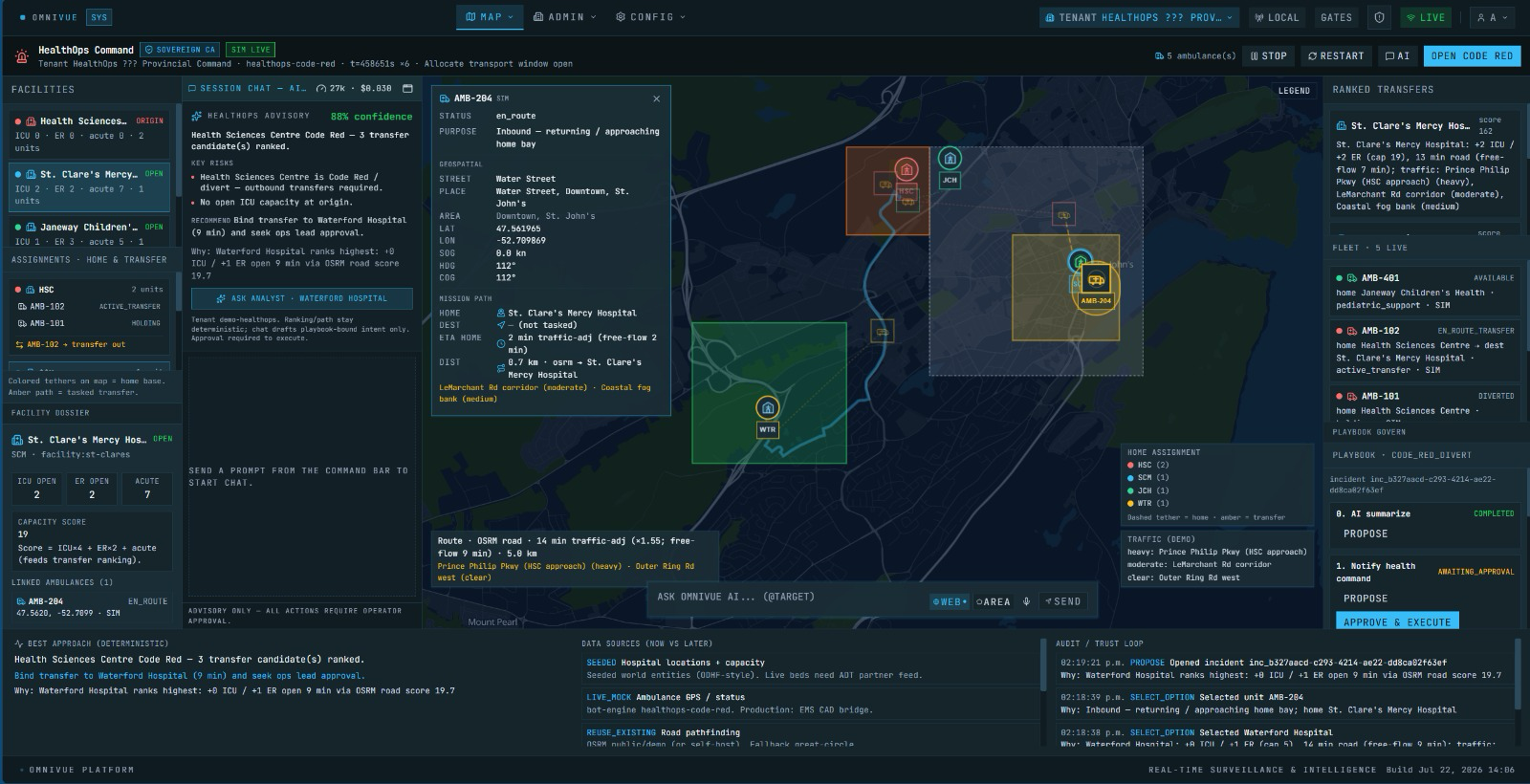
A low-disruption first engagement
Prove the workforce opportunity without changing a live schedule.
A 90-day parallel shadow pilot would compare omniVUE's proposed roster against the schedule actually used by a selected unit. The model runs in the background; existing staffing authority and processes remain unchanged.
Data & rule configuration
Connect agreed historical datasets, define the pilot unit and translate workforce policies and collective-agreement constraints into testable rules.
Parallel shadow operation
Run the proposed roster alongside the actual schedule without changing live assignments. Record call-ins, gaps, coverage decisions and cost triggers.
Comparative evaluation
Compare the two approaches across coverage, overtime exposure, agency reliance, administrative effort, rule compliance and preference matching.
PILOT EVALUATION
Measure the difference before making the decision.
Final targets and baselines would be agreed with the participating health organization. No savings or performance result is claimed before the pilot is completed.
- Projected overtime and agency-cost avoidance
- Configured rule and rest-period compliance
- Time required to draft and revise schedules
- Skill-mix and qualification coverage
- Staff preference and leave accommodation
- Quality and explainability of recommendations
Designed for Canadian health-system control
Operational intelligence that fits the governance model.
A deployment would be configured around customer data residency, privacy, organizational roles, collective agreements and approval authority. omniVUE is designed to work as an operational layer—not replace the systems that hold clinical or workforce records.
Discuss deployment requirementsCONFIGURED INPUTS
- Historical census and acuity trends
- Current rosters, availability and leave
- Qualifications, roles and skill requirements
- Collective-agreement and local scheduling rules
- Facility capacity and patient-flow signals
- EMS, transport and configured operational systems
A focused path to a saleable pilot
Start with one unit, one scheduling problem and ninety days of evidence.
Select a high-variability unit, agree on the rules and evaluation measures, then compare the actual roster with omniVUE's proposed schedule in a controlled shadow environment.